Jewelry Buying Guide
Jewelry Buying Guide
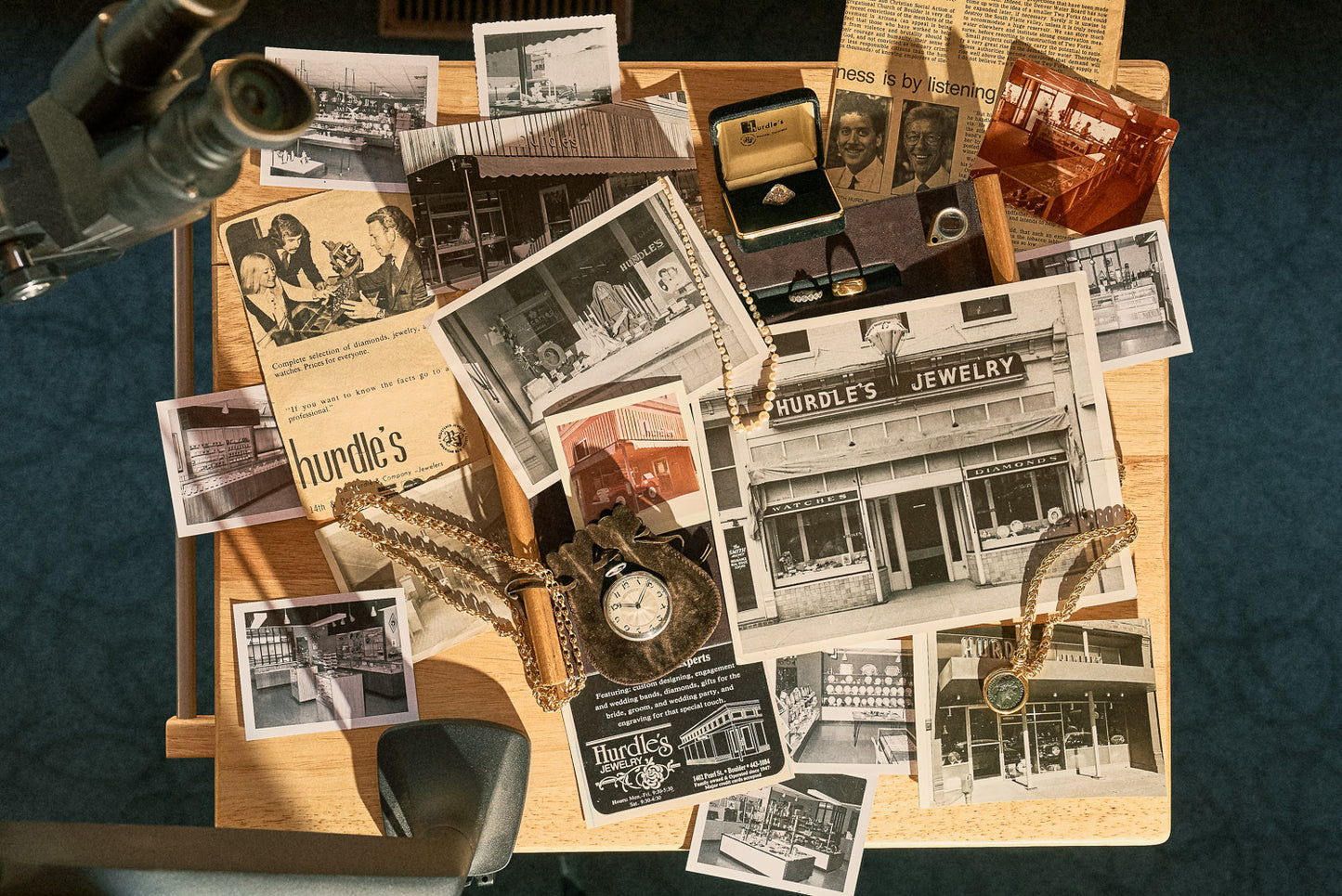
An Educational Resource from Hurdle’s Jewelry, Established 1947
For over seven decades, Hurdle’s Jewelry has offered fine jewelry crafted with precision and care. The following guide provides essential information for understanding diamonds, gemstones, metals, pearls, and other technical considerations when selecting or evaluating a piece of jewelry.
Diamond Education: The 4 C’s
Shape
Often confused with cut, shape refers to the geometric form of a diamond. Common shapes include round, princess, oval, pear, and marquise.
Cut
The cut determines how well a diamond reflects light. A properly cut diamond will appear brilliant and lively, while one that is too deep or shallow may look dull.
Color
Diamonds are graded on a scale from D (colorless) to Z (light yellow or brown). Near-colorless diamonds (G–J) offer excellent value while maintaining a bright appearance.
Clarity
Clarity refers to the presence of natural internal or surface characteristics, known as inclusions and blemishes. Grading ranges from Flawless (Fl) to Included (I3).
Clarity Scale:
-
FL – Flawless
-
IF – Internally Flawless
-
VVS1–VVS2 – Very, Very Slight Inclusions
-
VS1–VS2 – Very Slight Inclusions
-
SI1–SI2 – Slight Inclusions
-
I1–I3 – Inclusions visible to the naked eye
Carat Weight
Diamonds are weighed in carats, with one carat equal to 0.2 grams. Size does not always increase proportionally with weight due to variations in density and cut.
Gemstone Enhancement Codes
Published by the American Gem Trade Association (AGTA)
Enhancement: Any treatment process other than cutting and polishing that improves the appearance (color/clarity/phenomena), durability, or availability of a gemstone.
| Code | Description |
|---|---|
| N | Used for natural stones not currently known to be enhanced. May be used when a seller guarantees no enhancement has been applied. |
| E | Indicates a gemstone has undergone its traditional enhancement process. |
| B | Bleaching: Use of heat, light, or other agents to lighten or remove color. |
| C | Coating: Surface treatments such as lacquering, enameling, foiling, or films to enhance color or effects. |
| D | Dyeing: Introduction of coloring matter to intensify or alter hue. |
| F | Filling: Use of glass, plastic, or borax to fill cavities or fissures, improving durability and appearance. |
| H | Heating: Alters color, clarity, or visual phenomena. If residue from treatment is visible under 10X magnification, use "HF". |
| HP | Heat & Pressure: Combined treatment to alter color and clarity. |
| I | Impregnation: Filling of porous gemstones with colorless agents (usually plastic) for durability and luster. |
| L | Lasering: Laser plus chemicals used to reach and alter inclusions in diamonds. |
| O | Oiling/Resin Infusion: Filling of fissures with colorless oil, wax, or resin to enhance appearance. |
| R | Irradiation: Alters color using neutrons, gamma rays, or beta particles. Often followed by heat. |
| U | Diffusion: Chemical and heat treatment used to produce artificial color or optical effects. |
| W | Waxing/Oiling: Surface enhancement of opaque or porous stones using wax or oil for visual improvement. |
Gemstone Education: The 4 C’s of Colored Stones
Gemstones are evaluated using a similar framework, though each variety is graded within its own species.
Shape & Cut
Gemstones may be faceted to enhance brilliance or cut as cabochons (domed) for softer stones. Popular shapes include round, marquise, pear, and oval.
Color
The most important quality factor for most colored stones. Gems are evaluated based on hue, tone, and saturation. Preferred colors vary by type.
Gemstone Color Chart:
-
Red – Mozambique Garnet, Ruby
-
Pink – Rhodolite, Pink Sapphire
-
Yellow – Yellow Sapphire, Citrine
-
Green – Bloodstone, Emerald, Jade, Peridot
-
Blue – Aquamarine, Blue Chalcedony, Blue Spinel, Blue Zircon, Lapis, Blue Sapphire
-
Purple – Amethyst, Tanzanite
-
White – Akoya Pearl, Freshwater Pearl, Mabe Pearl, South Sea Pearl, White Spinel, White Topaz, Moissanite, Opal
-
Brown – Smoky Quartz
-
Black/Grey – Tahitian Pearl, Onyx
Clarity
Gemstones such as emeralds naturally contain more inclusions than others like aquamarine. Clarity grading is adjusted accordingly per gemstone type.
Carat Weight
Measured the same as diamonds, though perceived size may vary depending on the stone’s density.
Diamond & Gemstone Weight Ranges
Diamonds and gemstones are often sold in calibrated weight ranges. Refer to the chart below for approximate equivalents.
(Insert gemstone weight chart here; consider visual formatting or downloadable PDF.)
Pearl Education
The Cultivation Process
Due to the rarity of natural pearls, cultured pearls are now the standard. A polished shell bead is inserted into a mollusk or oyster to trigger nacre production, forming a pearl over 12–24 months.
Types of Pearls
-
Akoya – The first type to be cultured. Known for roundness and high luster. Primarily from Japan and China. Colors: white, cream, grey, black.
-
Freshwater – Generally more irregular in shape and size. Lower in cost and cultivated mostly in China.
-
Mabé – Grows against the shell, not within the body. Dome-shaped and resin-backed. High luster, lower cost.
-
South Sea – Cultured in northern Australia, Indonesia, and the Philippines. Naturally white, cream, or golden. Larger and more sensitive to cultivate.
-
Tahitian – Cultured in Tahiti. Naturally occurring black, silver, and grey hues. Slightly smaller than South Sea pearls.
Pearl Characteristics
-
Color – Varies from white, cream, yellow, pink, silver, to black. Most pearls display a primary body color and a secondary overtone.
-
Luster – Result of the nacre’s depth and thickness. Indicates the pearl’s ability to reflect light.
-
Shape – Round is most prized. Akoya, Tahitian, and South Sea tend to be rounder. Irregular shapes are unique and more affordable.
-
Surface – Natural growth often results in spots or irregularities. Flaws may be minimized through design and stringing.
-
Size – Determined by the mollusk and duration of cultivation. Size impacts price significantly when paired with ideal shape and luster.
Metal Types
There are a variety of metals choices available for jewelry. Whether you like the allure of platinum or the range of options with the classic gold, you will find a number of stylish pieces, sometimes even combining the two metals. Today, alternative metals like sterling silver, titanium, and stainless steel give you additional options in look, strength, price, etc. Each choice has its own qualities, so base your choice on the ones that you value most.
Platinum
Platinum is generally 95% pure and does not tarnish or lose its rich white luster. Platinum is the heaviest of all the precious metals weighing approximately twice as much as karat gold. Its purity makes it hypoallergenic, perfect for people who are sensitive to the alloys used in gold. Platinum is also known for its strength and pliability, just one gram of platinum can drawn into a fine wire over one mile long.
Gold
Pure 24 karat gold is rarely used in jewelry because it is too soft for frequent wear. Gold is mixed with alloys like copper, silver, nickel, and zinc to give different colors, strength, and durability.
Gold's purity is measured in karats, which indicate out of 24 parts how many parts are gold. For example, 18kt gold contains 18/24 gold and 6/24 alloy, while 14kt gold contains 14/24 gold and 10/24 alloy. Gold is traditionally seen in yellow and white colors, but can also be available in rose or green on occasion.
Sterling Silver
Sterling silver is usually 92.5% silver and 7.5% copper. Silver is much more plentiful than platinum or gold and is much less expensive. It takes on a much higher polish than any other metal, but it does tarnish. The tarnish can be removed, but silver requires much more care than other metals.
Titanium
Titanium is a light, strong, and corrosion-resistant metal. Titanium offers you seven times the strength of platinum at about 1/3 of the weight. It is the hardest natural metal on earth and therefore offers more scratch resistance than gold or silver. In addition, titanium is also hypoallergenic. When ordering titanium rings, be extra sure about your ring size. The biggest drawback of titanium rings is that they cannot be sized by traditional ring sizing methods.
Stainless Steel
Stainless steel is a low cost alternative to traditional metals. It is naturally hypoallergenic and will not rust or tarnish. Stainless Steel will not break or bend under normal usage and is stronger than any other alloy.
Ring Sizing
Custom ring sizing is available at no additional charge for most designs.
Use our Ring Sizer PDF to determine your size:
-
Method 1: Use the paper sizer strip to measure around your finger.
-
Method 2: Match an existing ring to the printed circles.
Note: Cold fingers measure smaller. If results differ, choose the larger size for comfort. Custom-sized rings are final sale.
Additional Resources
-
Jewelry Cleaning & Care Guide (optional future link)